This is not the front page

Using Gamification in the classroom

Instance Description

Integrating gamification into face-to-face and digital learning environments can enhance student engagement and make learning more enjoyable. If well designed and implemented with intentionality, gamification can provide numerous benefits for learners, including increased intrinsic and extrinsic motivation, support for the attainment of the learning objectives, and a positive impact on the learning experience. 
Gamification can take many forms, and numerous technological levels can be explored. For example, simple games may rely on a few basic rules and the use of pencil and paper, or more complex designs may require several phases with complex rules and technologies.

Image
The words Learning, User Engagement, Motivation, Achievement, Reward, and Challenge connected with lines to the word Gamification in the middle.
Photo Credit

Credit: "© 300_librarians / Adobe Stock.” Accessed April 22, 2026.

Related Topics

See it in Practice

Image
Trivial Pursuit card with three questions. 1. Meteorology, What instrument measures air pressure?, Geosciences, What type of plate boundary creates most earthquakes? Human Geography, What is a city that dominates the economy and culture of a country called?
Photo Credit

Credit: ChatGPT, response to “Trivial Pursuit Card,” ChatGPT, April 22, 2026.

Trivia games are an excellent fit for educational contexts and allow the instructor to evaluate students’ acquisition of the information being taught. This type of game also tends to be relatively easy to implement in face-to-face and synchronous online environments. Use the following steps to integrate this into your course.

  1. Determine if this will be an individual or team game.
  2. Identify the categories of the questions you want to ask and draft questions for each category. You could also divide questions by cognitive level, offering questions that vary in difficulty and point value.
  3. Provide the students with the parameters (or instructions) of the game.
  4. Engage your students in the game. You can offer prizes to the winner/winning team or offer some other 'perk' (like extra credit) as an incentive to do well.
     

Considerations

Introduce foreign students and non-native speakers to the American games that your activity draws from, for example Jeopardy or Family Feud.

Contributor(s)

Image
Teams competing for prize. People playing tug-of-war, pulling rope with golden cup in the middle
Photo Credit

Credit: (2026). Teams competing for prize. Freepik.

Incorporating a competitive element into your gamification efforts can be a fun and effective method for enhancing learners' motivation. However, adding a competitive, yet friendly, aspect to the learning process needs to be intentional and short term. To maintain balance, strive to incorporate games that include both competitive and cooperative aspects. The goal of any educational game should maintain a strong focus on the content.

One example of this type of activity is to divide students into groups, have them complete a problem set, and reward the group that produces the closest correct answer (or the highest number of correct answers). To integrate this into your class, you can use these steps:

  1. Determine the problems or challenges you want students to solve.
  2. Divide learners into small groups. Groups should be large enough to accommodate different approaches, but small enough for everyone's voices to be heard (typically 3-5).
  3. Give learners a deadline.
  4. Review the answers with the students and award a small prize to the group with the correct (or closest to correct) answer.

Implementing this sort of game in an asynchronous online environment can be slightly different. Small groups may be given a set period (a day or a week) to share work and discuss it in a collaborative space such as a Google doc or a shared Groups space in Canvas.

If a synchronous Zoom meeting can be held for online students, breakout rooms can be used so that small groups can collaborate, followed by a whole-class discussion of results. Shared documents like Google docs can be used in real time by online students who are together in breakout rooms. During whole-class discussion, these documents can be shared, via Zoom screen sharing, with the entire class.

Reflect on this activity and modify as necessary to ensure equity and fairness.

Contributor(s)

Image
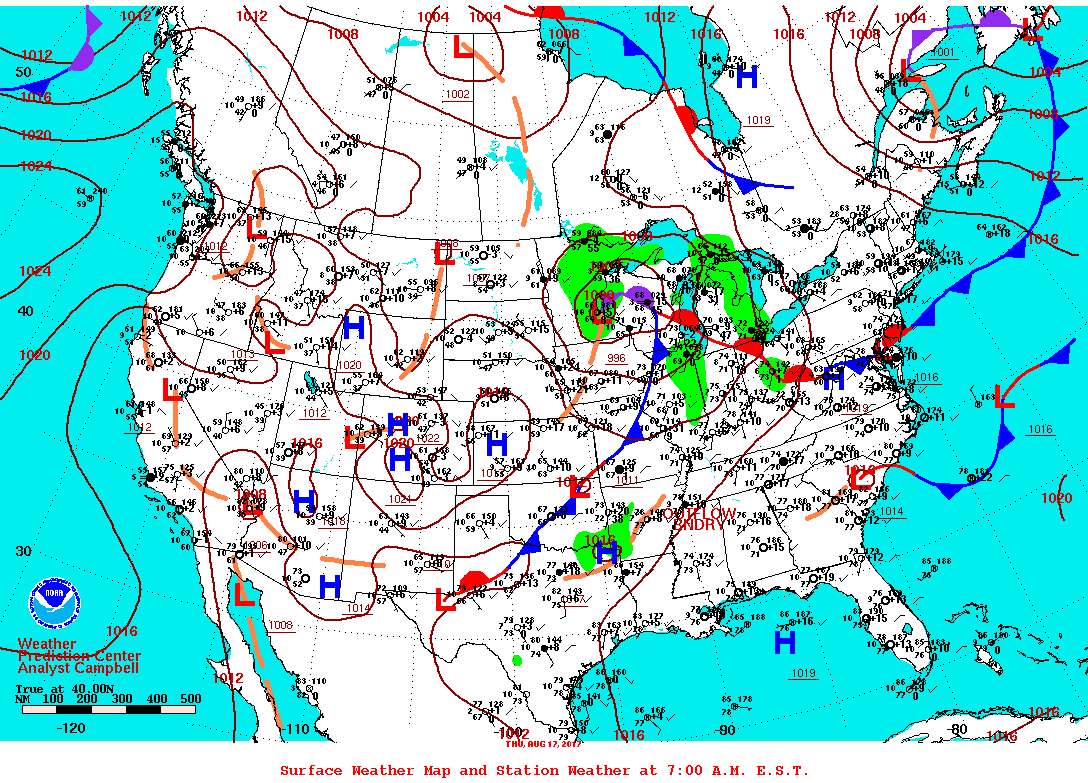
Weather Map
Photo Credit

Credit: National Centers for Environmental Prediction [Public domain]

METEO 410: Advanced Topics in Weather Forecasting is the final course in Penn State’s Undergraduate Certificate in Weather Forecasting. One way this course piques the interest of students and provides activity relevant to their career goals is with required participation in the national collegiate weather forecasting competition called WxChallenge. This 10-week challenge has students making and assessing real-life forecasts utilizing real-time data. The goal is for students to beat the computer and outperform their peers from across the nation. Students are encouraged to discuss their observations and thought processes with each other and the instructor in online discussion forums.

Students in METEO 410 consistently outperform the computer models and often rank among the top 5-10% of students nationwide. Course reviews and Student Ratings of Teacher Effectiveness (SRTEs) for this course are exceptional, in large part because students see the value and relevance of the work they are doing, and have done in previous courses, to the real world. Below is one example of a student comment:

“...I provided the highest ratings to the instructors and course materials [for METEO 101, 241, and 361 ] ...However [METEO] 410 was even a cut above each of those previous three courses in terms of sheer hands-on learning and student/instructor engagement."

Considerations

While this example is based on a pre-established competition, something similar could be created easily for use in a single class or in multiple sections of the same class.

Contributor(s)

References/Resources

Contributor(s)